Founders keep losing deals to worse products that already have a monthly subscription. Here is what actually breaks that.
“Do you like spending twenty dollars a month on brand name razors? Nineteen go to Roger Federer.”
That is Michael Dubin, in a warehouse in Venice, California, riding a forklift, talking directly into a $4,500 camera. He is not describing his product. He is describing yours. The one you already own. The one that is, by every reasonable measure, fine.
Dubin was not trying to beat Gillette on blade technology. Gillette had the technology. Five blades, a vibrating handle, a strip of aloe, at one point an actual built in flashlight. Dubin’s pitch was that none of it mattered. You do not need the flashlight. You need a blade that works, for a dollar, delivered to your door before you run out.
Four years later Unilever bought Dollar Shave Club for a billion dollars. Gillette’s market share went from 70% to 54%.
This is the story every founder with a “good enough” problem needs to sit with for a minute, because it contains the whole argument. Dubin never once tried to win a feature comparison. He could not have won a feature comparison. Gillette’s R&D budget alone was bigger than his entire company. So he changed what the argument was about.
That is the pattern behind every single example in this piece. Not a better product. A different fight.
THE OBJECTION THAT ISN’T ABOUT YOUR PRODUCT
Every founder has heard some version of this sentence, and almost none of them are hearing it correctly.
If you have sold B2B software for more than a month, you know the sentence. “Cool product, we like it, but we already use [incumbent] for that.”
The instinct is to respond with a feature. Ours does X, theirs doesn’t. Nine times out of ten this fails, and it fails for a reason that has nothing to do with X. The buyer is not comparing your product to the incumbent’s product. They are comparing the effort of switching to the effort of doing nothing. And doing nothing always wins that comparison, because doing nothing costs them zero calories today.
Every example below is a different answer to the same question. If the buyer will not compare products, what do you make them compare instead.
THE RAZOR THAT MOCKED ITS OWN CATEGORY
Dollar Shave Club, again, because it deserves the full story. Mark Levine had 250,000 razors sitting in a warehouse in South Korea and no way to move them. Dubin had a background in improv comedy and no marketing budget. What they had going for them was a genuinely funny insight: the entire premium razor category was solving a problem nobody actually had.
5 blades, a vibrating handle, a flashlight. Real features on real Gillette products at the time. $1 a month. Dollar Shave Club’s entire pitch.
The video is one long joke at the incumbent’s expense, and it works because the joke is true. Nobody needed the flashlight. Dubin just said the thing everyone already suspected out loud, on camera, with a swear word in the title.
The move here is not “make a funny video.” The move is: find the place where your category’s incumbent has been quietly overselling complexity, and say so, bluntly, before anyone else does. Simplicity is not a weaker pitch than sophistication. It is a different pitch, and against a bloated incumbent it can be the stronger one.
THE PROTEST THAT WASN’T A PROTEST
San Francisco, February 2000. Moscone Center. A software company nobody had heard of is about to pull off the most expensive practical joke in enterprise sales history.
Siebel Systems owned CRM. Forty five percent market share in 2002, on premise software, seven figure implementations, the whole category built around the assumption that switching cost was a moat. Marc Benioff, a 34 year old former Oracle executive, had a cloud based competitor with a fraction of the budget and a much bigger problem: how do you get in front of Siebel’s entire customer base without their permission.
He paid $50,000 for a booth outside Siebel’s own annual user conference. He hired actors to stage a fake anti software protest, signs reading “The Cloud Must Go On,” chanting “the internet is really neat, software is obsolete.” He hired a fake news crew from a fake local station to film the whole thing and interview the fake protesters.
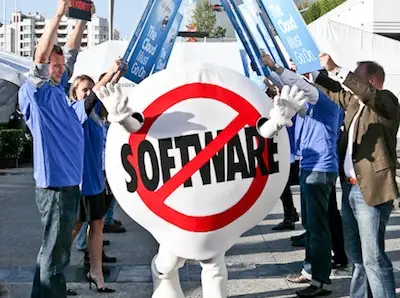
Real Wall Street Journal coverage followed within days.
Siebel called the police. This was, it turns out, the worst possible move. Real news vans showed up to film the police showing up to deal with the fake protesters, and a company nobody had heard of was suddenly the lead story. Business Insider later called Salesforce “the ant at the picnic.”
Months later Salesforce did it again, better. Siebel’s most exclusive annual event was in Cannes, and every attendee flying into Nice needed a taxi for the 45 minute ride to the venue. Salesforce rented every single airport taxi. Wrapped them in “No Software” branding. Trained the drivers to pitch Salesforce for the entire ride. Nobody arrived at Siebel’s conference without first sitting through a Salesforce sales call they could not exit.
Three years later, Oracle bought Siebel for $5.85 billion. Not because Salesforce out engineered them. Because Salesforce refused to have the conversation Siebel wanted to have.
The actual insight buried in the stunt: Salesforce’s buyers were not the executives who signed the enterprise contracts. They were the salespeople who had to use the software every day, a group traditional enterprise vendors had never bothered marketing to directly. Benioff skipped the person who was comfortable with the status quo and went straight to the people who hated using it.
THE TOOL NOBODY MEANT TO SELL
Slack has the opposite origin story to Salesforce, no stunt, no theater, almost an accident, and it is worth including specifically because the lesson is different.
Stewart Butterfield’s company, Tiny Speck, spent three years building a video game called Glitch. Cooperative, no combat, a strange hand drawn online world. It never found an audience. To keep a distributed team coordinated across Vancouver, San Francisco and New York while building it, the engineers threw together an internal messaging tool. Nothing fancy. Searchable, channel based, built purely so nobody lost context between time zones.
Glitch shut down in 2012. The messaging tool did not get shut down, because by then it was the only thing at the company that was actually working.
Nobody at Slack tried to win a bake off against email. Nobody pitched a CIO on replacing the company’s entire communication stack. Instead, individual teams started using it quietly, without asking permission, because it solved a problem they had every single day. Eight thousand companies signed up for the closed preview in the first 24 hours. By the time anyone with a budget noticed, half their own employees were already using it.
8,000 companies. First 24 hours. Closed preview, invite only, no ad spend.
Email is the ultimate “good enough” incumbent. Free, universal, nobody has ever been fired for using it. Slack did not ask anyone to give it up. It just made itself indispensable to the people doing the actual work, and let the budget conversation happen after the fact, when it was already too late to say no.
THE PLAQUE ON THE DOOR
London, 1680s. No fire brigade. No 911. Just a badge on your front wall and a bet that someone will show up.
Step back three and a half centuries for the oldest version of this story, because it strips the whole argument down to its bones. The Great Fire of London destroyed 13,200 houses and 87 churches in 1666. A doctor and economist named Nicholas Barbon looked at the wreckage and founded the first fire insurance company shortly after.
There was no municipal fire service. Insurers ran their own private brigades, watermen from the Thames in colored uniforms, and they needed a fast way to know which houses they were financially on the hook for. So policyholders nailed a small metal plaque to the front of the building. A firemark. Clasped hands. A phoenix. A fireplug.

Still visible today on older buildings in London, Philadelphia, Charleston.
The legend that grew up around firemarks is that a rival brigade would arrive at a burning building, check the plaque, see the wrong company’s symbol, and simply leave it to burn. Historians have mostly debunked this. No fire company wanted a blaze spreading to a neighboring insured property either, and the reputational cost of watching a house burn on purpose would have been catastrophic. But the legend persists for three hundred and fifty years anyway, and that persistence is the actual point of including it here.
Nobody buys fire insurance because of a feature comparison. They buy it because they can picture the fire. The firemark did not sell fire suppression technology. It sold the visible, public, front-of-house removal of a fear that had not happened yet, and the whole category still runs on that same emotional mechanism today, four hundred years later, whether the story about who gets left to burn is even true.
This is the oldest trick in the piece and it still works: your buyer is not weighing your product against a competitor’s. They are weighing a fear they have not felt yet against a bill they can feel right now. Make the fear specific and nameable, and the bill stops winning by default.
WHAT ACTUALLY WORKED, PULLED APART
Four completely different tactics. One identical refusal underneath all of them.
None of these four founders tried to win the argument the incumbent had already set up. Here is what they did instead, and how to steal it.
Name the cost of doing nothing, specifically. Fire insurance sold nothing but this. Find your category’s version of the fire next door, the outage, the fine, the customer who churned, the near miss that almost went badly, and build the pitch around that instead of the spec sheet.
Go around the person who is comfortable, not through them. Salesforce and Slack both ignored the buyer who was fine with the status quo and won the people underneath them first. If your buyer is satisfied, they are not your entry point. Find whoever is quietly annoyed by the incumbent every single day and start there.
If you cannot out feature them, out simple them. Dollar Shave Club did not compete with Gillette’s R&D budget. It made fun of it. Simplicity is a real position, not a consolation prize, especially against an incumbent whose whole story is more.
Make staying put look like the effort, not the safe choice. Every example here reversed the emotional weight. Staying with Siebel started to look bureaucratic. Staying with Gillette started to look gullible. Staying with email started to look chaotic. Switching has to feel like relief, not risk.
Do not ask for a replacement decision if you can avoid one. The hardest sell in B2B is “rip out what you already have.” The easiest sell is “this fixes the thing you are already annoyed about.” Wedge in next to the incumbent before you ask anyone to replace it, if that path exists at all.
Borrow real stakes, not manufactured urgency. Every one of these used something true, an actual fire, an actual overpriced flashlight, an actual inbox nobody could keep up with. Fake scarcity reads as fake scarcity. Real stakes do not need dressing up.
THE PART NOBODY PUTS IN THE PITCH DECK
Here is the thing worth sitting with on the way out. Every founder in this piece was, at the moment they made their move, smaller, poorer, and less credible than the incumbent they were up against. Dubin had $4,500 and a warehouse full of unsold razors. Benioff was renting a booth outside someone else’s conference because he could not afford to throw his own. Butterfield was closing down a failed video game.
None of them waited to be big enough to compete on the incumbent’s terms. They picked a different set of terms, ones where being small and specific and slightly absurd was an advantage instead of a liability. That is available to you too, right now, at whatever size you currently are. The incumbent’s size is only an advantage inside the argument they have already set up. Change the argument and it stops mattering nearly as much as it looks like it does from where you are sitting.
If you are staring down a “good enough” incumbent this week, tell me what it is. angkan.mukherjee@gmail.com
Further Reading
- “The $4,500 Video That Broke the Internet and Literally Built a Billion Dollar Brand.” Planet Small Business, April 2025.
- Dollar Shave Club. Wikipedia.
- “They Called The Police?” The Marketing Millennials, May 2024.
- “The End of Software: The Origin Story of Salesforce.” Stacksync, March 2026.
- “Salesforce at 20 Offers Lessons for Startup Success.” TechCrunch, March 2019.
- “The Slack Origin Story.” TechCrunch, May 2019.
- “How Slack Co-founder Stewart Butterfield Turned a Failed Game into a $28B Workplace Platform.” Founded.com, March 2026.
- “The World’s First Insurance Company.” IRMI, July 2001.
- “Inside the Collections: Fire Insurance Markers.” Litchfield Historical Society, June 2024.
- “FIREMARKS: Insurers on Their Marks.” Insurance Times Archive, October 2000.